Publicity!

I made the news today – and while an actual review would have been nice, I will take free advertising without complaint!  This article appeared on the front page of the Today section in The London Free Press, and I am grateful to them!  Nice to be featured with these other excellent artists as well.

I have decided to post my own watermarked photo of the featured painting they chose for the article – it will give you a better idea of the colour.  This is one of the five watercolours on gesso that are in the exhibit, and it’s called Colourfest.  Like the others, it began as a digitally generated fractal, and developed from there.

Colourfest, 20x20", Watercolour on Gessoed Paper.   Lianne Todd

Colourfest, 20×20″, Watercolour on Gessoed Paper. Lianne Todd

Another item of publicity is this video made by The ARTS Project.  It was the end of the day we hung the show, so I hope I am not rambling too much in it.  You can see Colourfest hanging behind me!

Last Night’s Opening

A big thank you to everyone who helped me celebrate the opening of my exhibition last night.

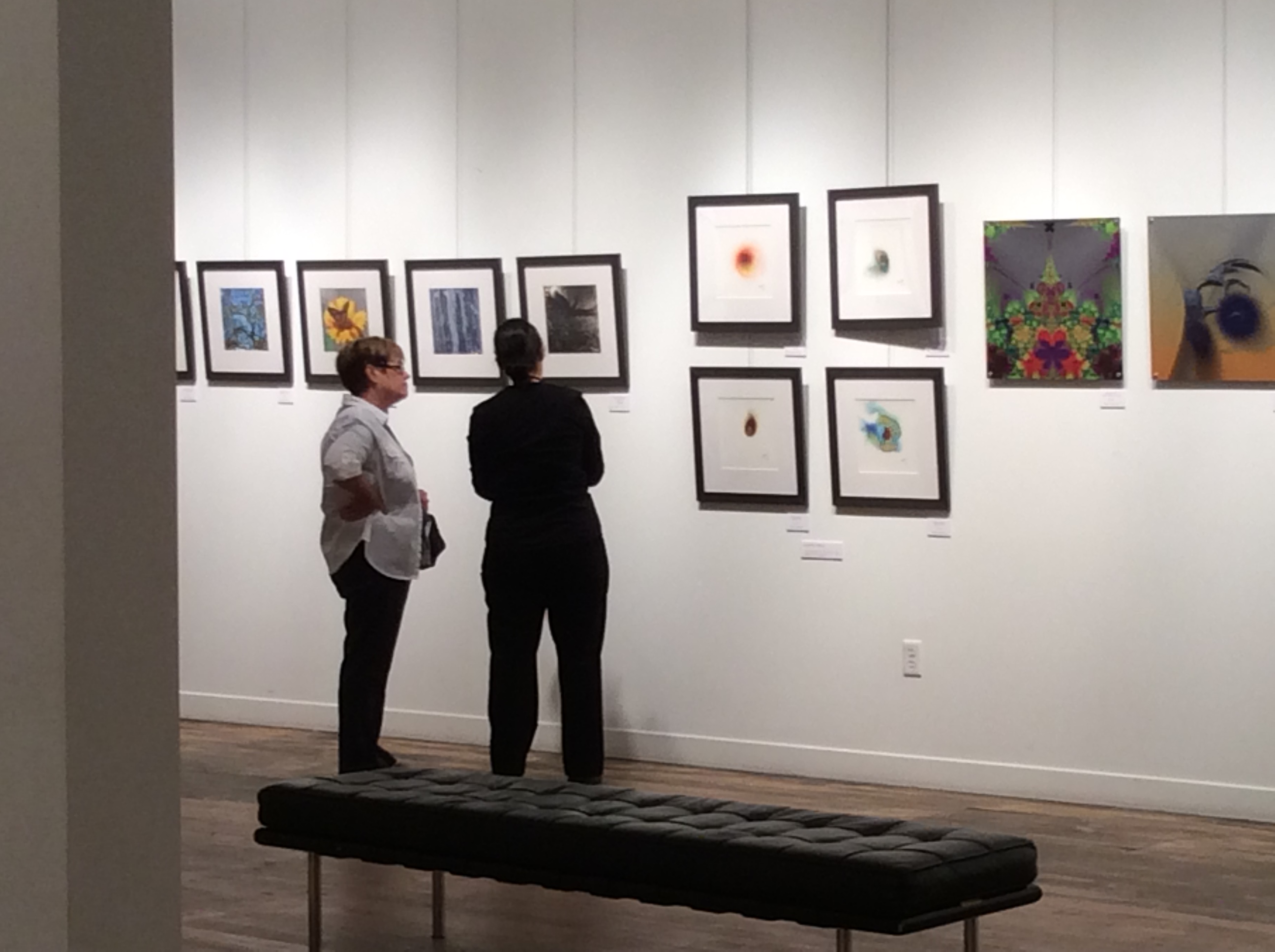
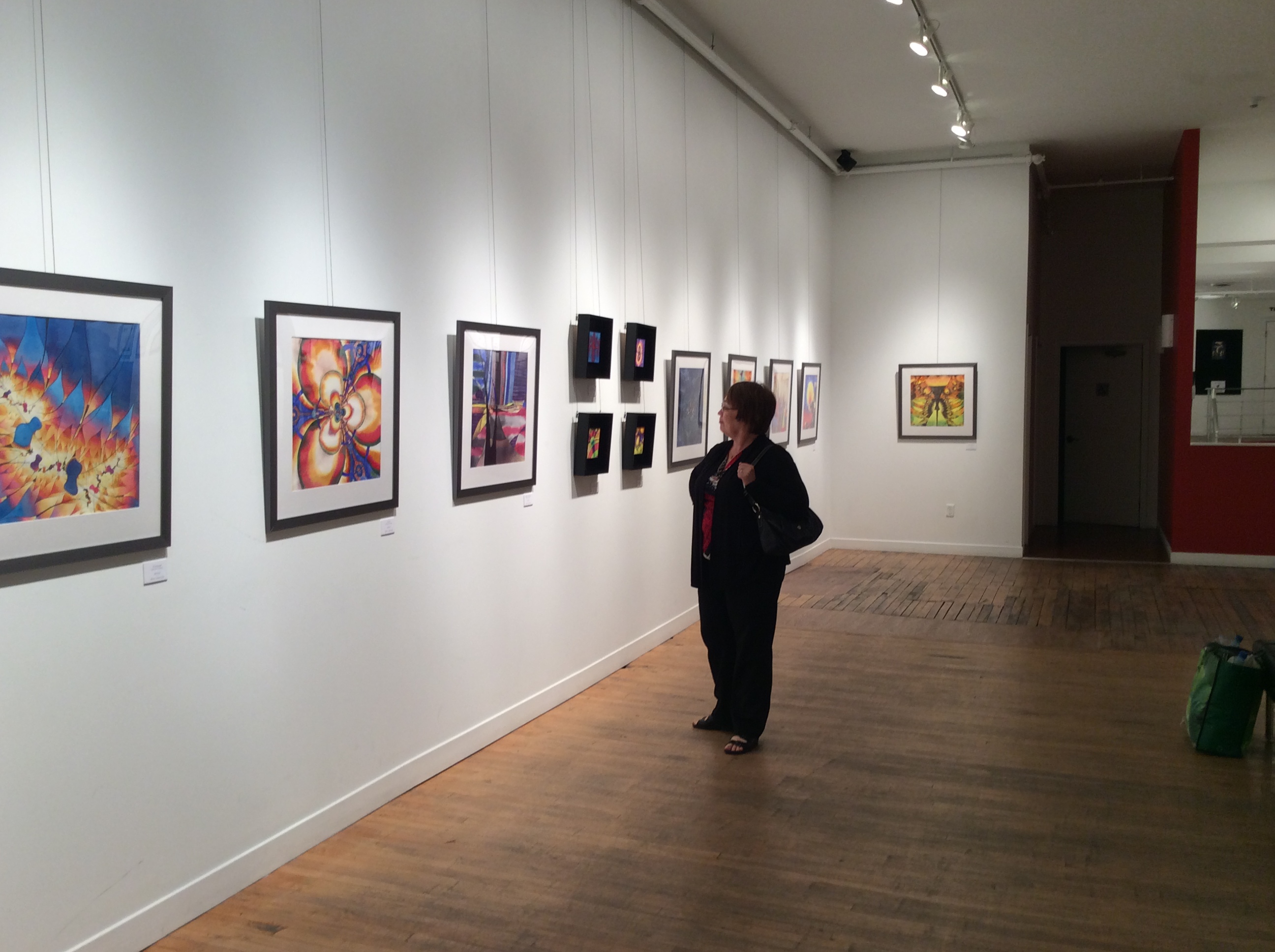
Here are some pictures  (I didn’t remember to take any until the end of the night!):

photo 3 photo 2 photo 1 photo

The Fractal Nature of Our Universe

Tonight is the night!  Yesterday we hung the art and it is all ready for viewing.  My husband helped, and he was wondering where I had been hiding it all.  Here is a sneak peak at some of the titles for you, and a photo of me hanging some of my first ones on the wall of the lovely gallery at The ARTS Project.

“Turbulence & Bubbles”; “Stardance”;  “Nature’s Drapery”;  “Negative Nebulae”;  “Mother of Moths”; “Fried Eggs”;  “The Mage Emerges”…  There are 39 pieces of art in all.

Here I am hanging "Happy Hill"

Here I am hanging “Happy Hill”

The ones  you see in the photo are watercolour paintings on paper.

I would like also, at this time, to acknowledge the excellent digital image printing services of Posterjack, of Toronto.  They are the company which I use to print my digital fractals on metal.  Over the course of three years they have consistently provided wonderful service and attention to quality.  The show consists of 18 paintings, 15 metal prints, and six photographs.  The photographs were printed using high quality archival paper and inks by Highlander Studios, of Woodstock, and I am so pleased with the results!

Some other tools I have employed to make my art are the software which I use to generate the fractals I start with.  I have primarily used Spangfract XTel, and Oxidizer, on my iMac.  These programs provide me with infinite possibilities and I thank them for that!  My frames and many of my other art supplies were purchased at Guthrie’s Art Supplies & Framing, of London – mainly because they also provide excellent service and reasonable prices – and Olga knows me when I walk in.  Richard and Sandra, at The ARTS Project, were very helpful with advice and equipment for hanging yesterday.  Finally, I would like to acknowledge the funding support from the Ontario Arts Council, an agency of the Government of Ontario.

I hope, if you are able, you will join me tonight as we celebrate the show opening.  7-9 pm!

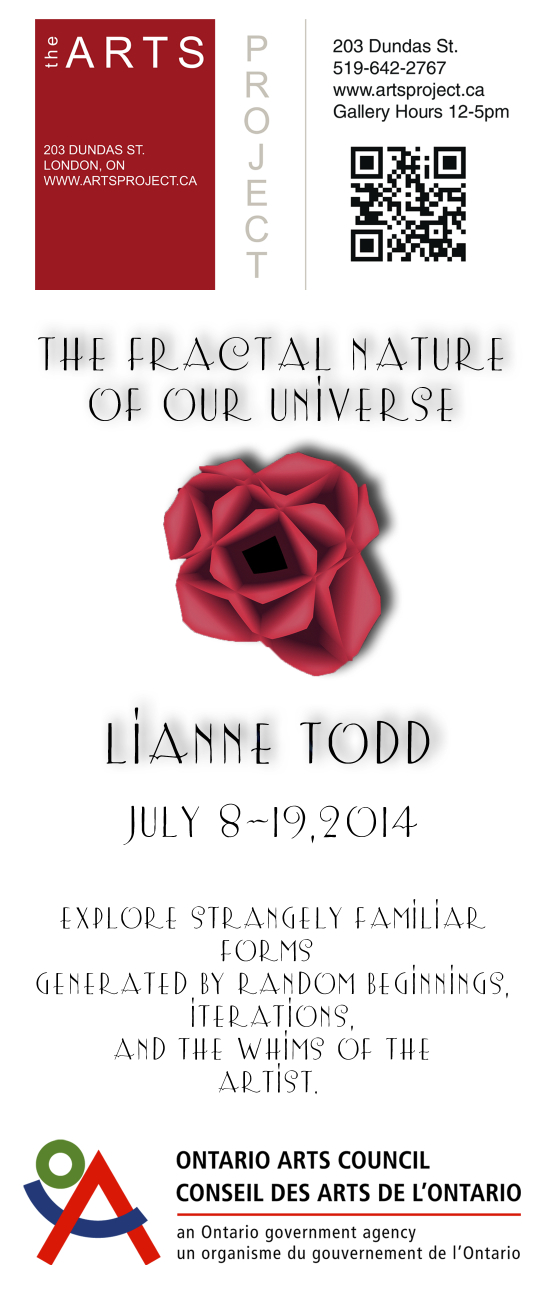
Show information

The ‘rose’ and the creation process.

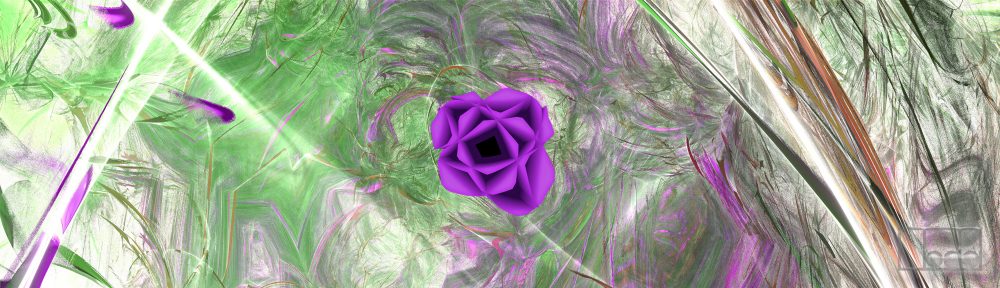
See the “rose” in the header of this blog?  It’s a selected portion of one of the first fractals I ever generated, using one of the many programs available for such purposes.  It was a completely random occurrence, really.  I was playing around with formulas, and voila!  One of nature’s most recognizable shapes, noted for its beauty, appeared before me.  A little colour tweaking, some removal of extraneous image parts, and there it was.

This is the wonderful thing about working with fractals.  It becomes readily apparent that mathematics is truly the language of the universe.  The fractal rose is not one of the pieces of art I’ll be showing at the upcoming exhibit in London, but it symbolizes the exhibit very well, which is why I have chosen it for my promotional materials.

Mathematicians have spent a good deal of time and effort to demonstrate the fractal geometry of various parts of nature, tweaking formulas for the very purpose of modelling it.  This has (in most cases) involved an analysis of natural shapes and distributions prior to the effort of coming up with a formula.  I, however, am not a mathematician.

Most of my images start on a whim. I should qualify this with the statement that I am standing on the shoulders of the people who have created the software I use.  Without their brilliance I wouldn’t be able to do any of this.  So… my images start on a whim, and they continue with further whims (what happens if I change this?), and even further whims.  The possibilities really are endless.  If the image strikes me, I render it in high resolution and save it.  Sometimes I save the parameters as well, sometimes I don’t. So, in a way, I am the natural selector, deciding which image survives, which parameters get passed along to the next selection process.  It never ceases to amaze me how often I am confronted with an image that triggers recognition of something that exists in our universe – or at least, the universe within my imagination.  These are the ones that are most likely to be selected for the creation of my art.  The next step is the editing that occurs before I consider a digital piece finished (sometimes several images are combined into one piece), or, the painting of the image that I was inspired by.  The paintings require a great deal of patience to execute.  I draw them on the paper (or gessoed paper, or aquabord) freehand, but I start with very precise measurement of the positions of the largest features.  I decide which pigments are best to represent what I like about the digital image, and if there is any element I don’t like and wish to change or omit.  Then comes the sorting out in my brain of the pattern, and how it repeats on smaller and smaller scales, and exactly how small of a scale it is possible for me to keep painting this pattern.  It is like a puzzle and I’m drawing the pieces and fitting them inside each other, to the limit of my brush size and my eyesight (and my resolve).  The results are very satisfying but I am usually at the end of my rope by that point and have to switch to my traditional paintings for a while just to retain my sanity!  This is one reason why this upcoming show is the culmination of three years of work.

Ultimately, all of my fractal art, digital or paintings, or photographs of nature, comes from the place in my brain where reality meets imagination.  A place where the universe seems to reveal itself to the part of my brain that can imagine both its most vast and its most infinitesimal features, and how they relate to each other.

I hope my fractal art will trigger your imagination as well!  Stay tuned (follow my blog  please!) and don’t forget to save the date:  July 8, 7-9 pm for the opening, and the exhibit runs until July 19, at The ARTS Project in London, ON.  (See previous post for more info)

My Fractal Art: An Introduction

A few years ago, in the fall of 2010, a famous piece of art (The Great Wave, by Katsushika Hokusai, 1760-1849) kept re-appearing in my life.  Though it contains fractal shapes, the artist, who lived more than 100 years ago, wouldn’t have called them that as the term hadn’t been invented.  However, it led me back to this fascinating topic which I had briefly been introduced to about 20 years ago.  I remembered my initial excitement, and the more I explored it, the more I felt this was the direction I needed to take to satisfy my artistic and my scientific nature all at once.  (I have been a watercolour painter for about fifteen years, and prior to that I worked in biology).  While the mathematical definition and the name (credit to Benoit Mandelbrot) are relatively new (circa 1975), the concept and patterning involved in them is hauntingly familiar.  The idea of dimensions as in 1-D, 2-D and 3-D is fairly straightforward.  A dot is 0-D, a curve or a line is 1-D, a surface or plane is 2-D, and a sphere or cube is 3-D, for example.  But as Benoit Mandelbrot said, “Clouds are not spheres, mountains are not cones, coastlines are not circles, and bark is not smooth, nor does lightning travel in a straight line.”¹  So, what if the best way to define something’s dimensionality is to use a non-integer, like, for instance, 0.6309, or, say, 1.2618?  Without going too far into the mathematics, which I myself barely understand, these are the situations where we use the term fractal.  Fractals are generally self-similar, on smaller and smaller scales.  There are many examples in nature, and also, many practical applications for fractal geometry in our lives.

Mandelbrot, sadly, passed away that same fall.  His legacy is a novel way to observe, appreciate, and replicate the natural world.  In fact, when I look at fractals, I often see everyday things.  And when I look at everyday things, I often see fractals.   My fractal art is an attempt to bring this idea of mine home:  Fractals may not be just a model for, but may be the underlying structure of our universe.

I hope you will join me in discovering a new way to look at the world.  Soon, I will add photos of my creations, but for now, let me invite you to the opening reception of my solo show, The Fractal Nature of Our Universe, which introduces my fractal art to the world and is to take place on July 8, 7-9 pm in London, Ontario, Canada.  Mark your calendar and follow this blog for more details at a later date!


1. MANDELBROT, B. B. 1977.  The Fractal Geometry of Nature.  New York: W.H. Freeman and Company.