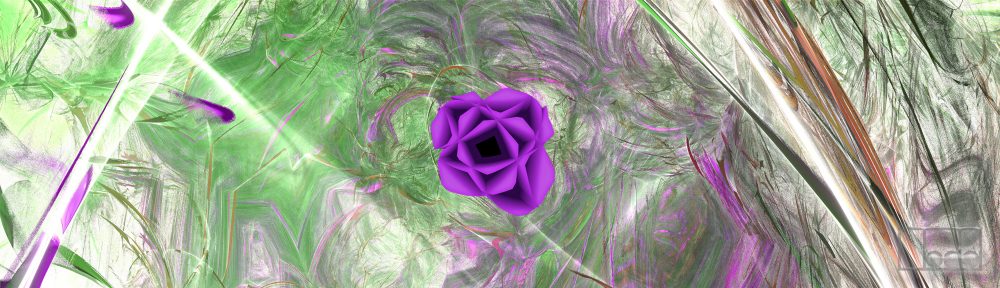
See the “rose” in the header of this blog? It’s a selected portion of one of the first fractals I ever generated, using one of the many programs available for such purposes. It was a completely random occurrence, really. I was playing around with formulas, and voila! One of nature’s most recognizable shapes, noted for its beauty, appeared before me. A little colour tweaking, some removal of extraneous image parts, and there it was.
This is the wonderful thing about working with fractals. It becomes readily apparent that mathematics is truly the language of the universe. The fractal rose is not one of the pieces of art I’ll be showing at the upcoming exhibit in London, but it symbolizes the exhibit very well, which is why I have chosen it for my promotional materials.
Mathematicians have spent a good deal of time and effort to demonstrate the fractal geometry of various parts of nature, tweaking formulas for the very purpose of modelling it. This has (in most cases) involved an analysis of natural shapes and distributions prior to the effort of coming up with a formula. I, however, am not a mathematician.
Most of my images start on a whim. I should qualify this with the statement that I am standing on the shoulders of the people who have created the software I use. Without their brilliance I wouldn’t be able to do any of this. So… my images start on a whim, and they continue with further whims (what happens if I change this?), and even further whims. The possibilities really are endless. If the image strikes me, I render it in high resolution and save it. Sometimes I save the parameters as well, sometimes I don’t. So, in a way, I am the natural selector, deciding which image survives, which parameters get passed along to the next selection process. It never ceases to amaze me how often I am confronted with an image that triggers recognition of something that exists in our universe – or at least, the universe within my imagination. These are the ones that are most likely to be selected for the creation of my art. The next step is the editing that occurs before I consider a digital piece finished (sometimes several images are combined into one piece), or, the painting of the image that I was inspired by. The paintings require a great deal of patience to execute. I draw them on the paper (or gessoed paper, or aquabord) freehand, but I start with very precise measurement of the positions of the largest features. I decide which pigments are best to represent what I like about the digital image, and if there is any element I don’t like and wish to change or omit. Then comes the sorting out in my brain of the pattern, and how it repeats on smaller and smaller scales, and exactly how small of a scale it is possible for me to keep painting this pattern. It is like a puzzle and I’m drawing the pieces and fitting them inside each other, to the limit of my brush size and my eyesight (and my resolve). The results are very satisfying but I am usually at the end of my rope by that point and have to switch to my traditional paintings for a while just to retain my sanity! This is one reason why this upcoming show is the culmination of three years of work.
Ultimately, all of my fractal art, digital or paintings, or photographs of nature, comes from the place in my brain where reality meets imagination. A place where the universe seems to reveal itself to the part of my brain that can imagine both its most vast and its most infinitesimal features, and how they relate to each other.
I hope my fractal art will trigger your imagination as well! Stay tuned (follow my blog please!) and don’t forget to save the date: July 8, 7-9 pm for the opening, and the exhibit runs until July 19, at The ARTS Project in London, ON. (See previous post for more info)


 FractaLiArt