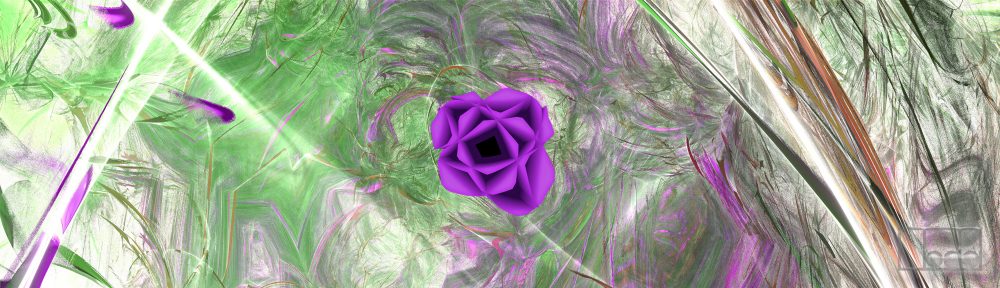
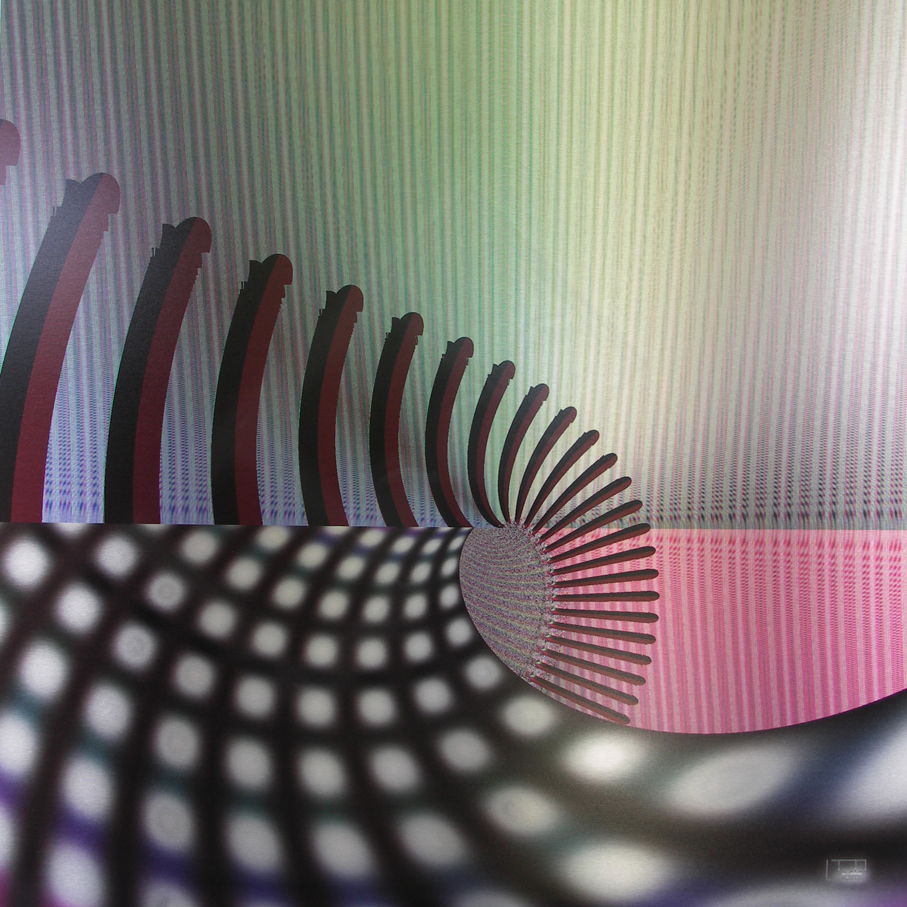
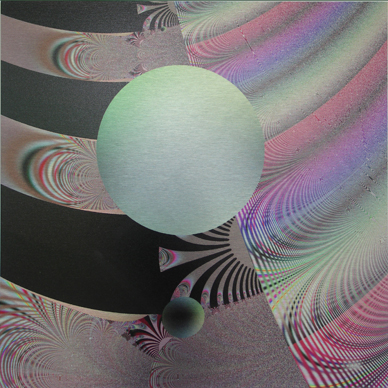
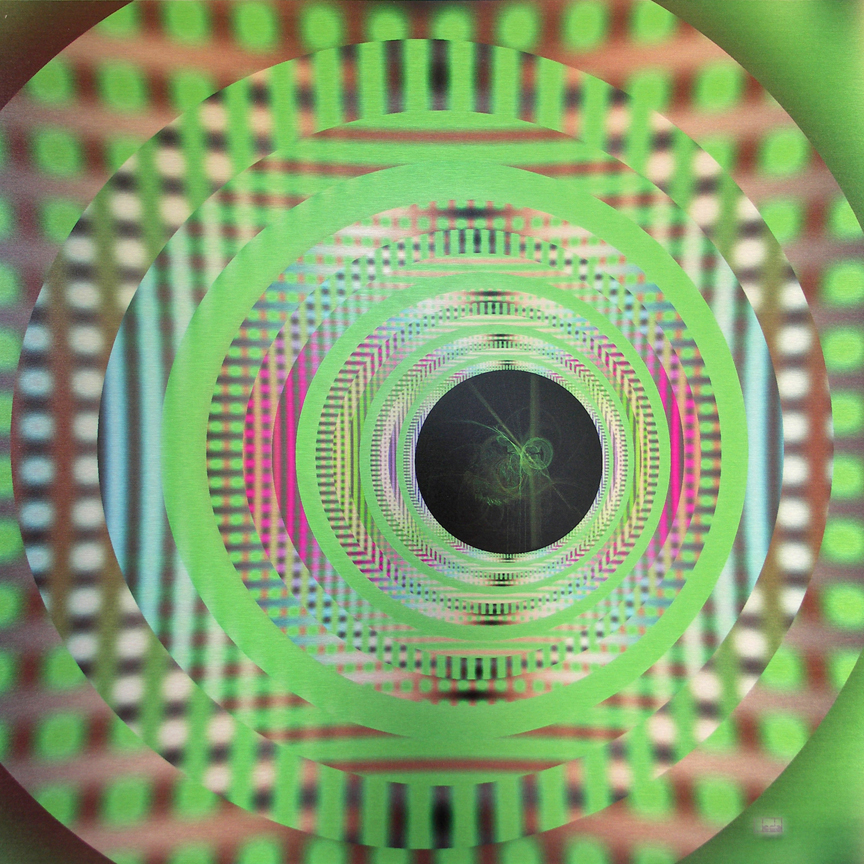
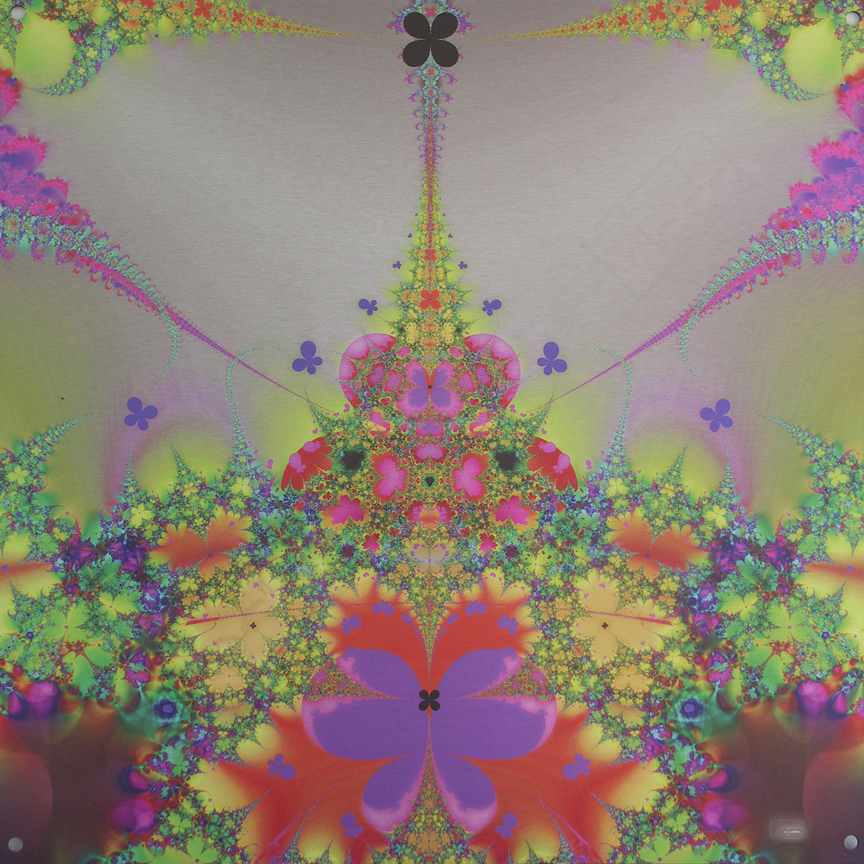
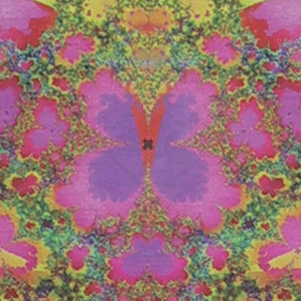
Often, when I’m voyaging through the through the little fractal universes I have generated using the software which I am so thankful exists, I encounter ‘places’ that look like they belong in an illustration for a book I’ve read somewhere along the way. I also encounter characters that look like they belong in those places. Such was the case for this piece:
Tag Archives: fractal art
Welcoming tourists!
The Landing
Congratulations to the European Space Agency, and to all of humanity, for boldly going where no one has gone before… for landing the human-built robot Philae on a comet!!
This is truly a historic moment and an example of how our imaginations can lead us to realities our ancestors may have considered impossibilities. It will lead to a greater understanding of our solar system and of the universe.
In honour of this event, I’m posting my piece called The Landing. I can’t think of a better day to do it! It’s purely imaginary, constructed of three different fractals, and belongs in the realm of fantasy or science fiction. But then, not so long ago, so did landing on a comet…

The Landing
Digital Art printed on metal, single edition
20×20″
Artist Lianne Todd
SOLD. Private Collection.
The Experiment
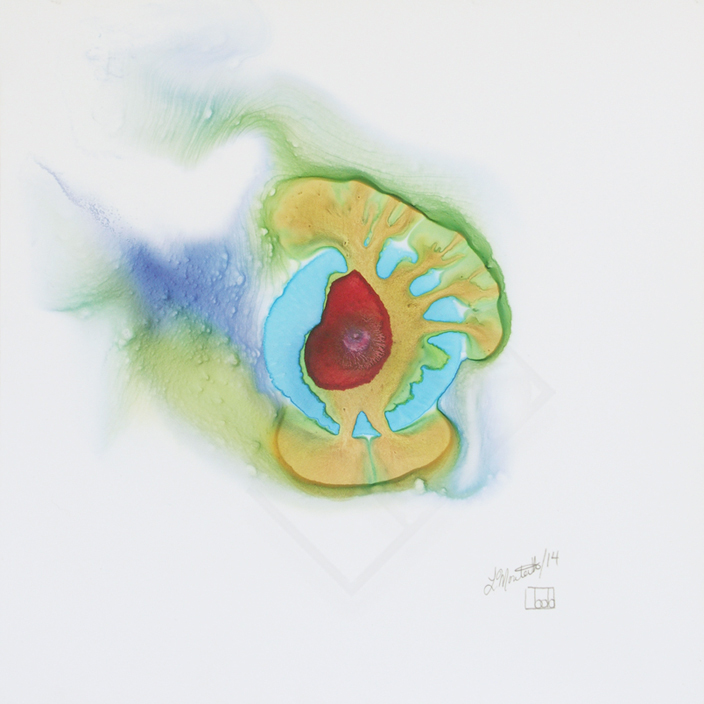
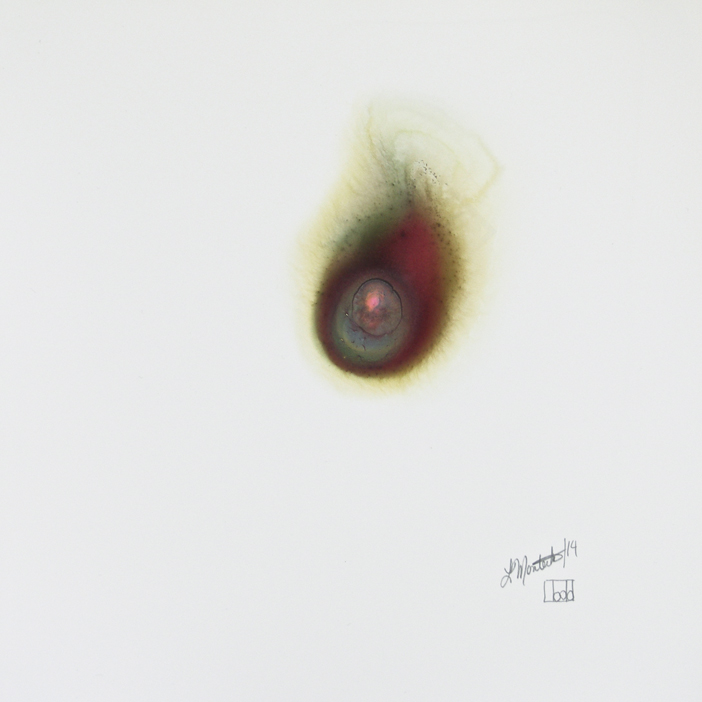
This series of four paintings was an experiment. Not a very scientific one but I did try to control variables and make predictions. My hypothesis was that since all pigments are different in their molecule size, shape, and hydrophilic and hydrophobic qualities, they would all move differently through the medium of water, and as they interacted with each other, and that their movement would be fractal. In other words, I expected them to appear, at the end, as if they were something like a cloud, or some other natural item that is already known to be able to be modelled using fractal geometry. A coastline, for instance.
All four pieces were executed and controlled in the same way (I won’t give away all my secrets!), the only differences being the pigments I used and the order they were used in. I tried to reduce the effects of gravity by levelling my table but it is kind of obvious there was a tiny bit of gravitational effect. I changed the orientation of the final products so that when they were hung together, it would be aesthetically pleasing. Other than that, the results you see here are basically the raw data.
I called them Negative Nebulae, because I looked at all the white space around them and imagined if it was black, and the colours were reversed, they would look a bit like those photos you see from NASA of distant nebulae. In other words, these would be like the negatives of those photos.
Here they are – what do you think?:
Here is what they looked like at the exhibit:
Curious to know what they do really look like when you invert the colours?
Open Studio/Gallery
On the third weekend in November, every year, we hold a studio tour in my town. Otterville is a historic town located in Southwestern Ontario, Canada. This will be our 18th annual studio tour – we call it Welcome Back to Otterville – and every year the stops on the tour change slightly as the artists in town do. This year, there are eight stops on the tour, so it will be really easy to drive out, see all the stops, and return home if you live in, say, London, Kitchener/Waterloo, Stratford, or the western part of greater Toronto. It takes me less than an hour to drive to London, and about two hours to downtown Toronto, exactly an hour to Stratford. We aren’t on any major highway, but if you want directions please contact me and I’ll be happy to provide them.
If anyone reading this has been to my studio before, you will find this year quite different as I will be featuring my fractal work prominently. In fact, in the next few weeks I’ll be taking down all the art in my gallery at the rear of my house, and completely rearranging the walls to maximize the display. I always serve a lovely hot spiced cranberry punch during the tour, and I’m looking forward to the taste of it myself!
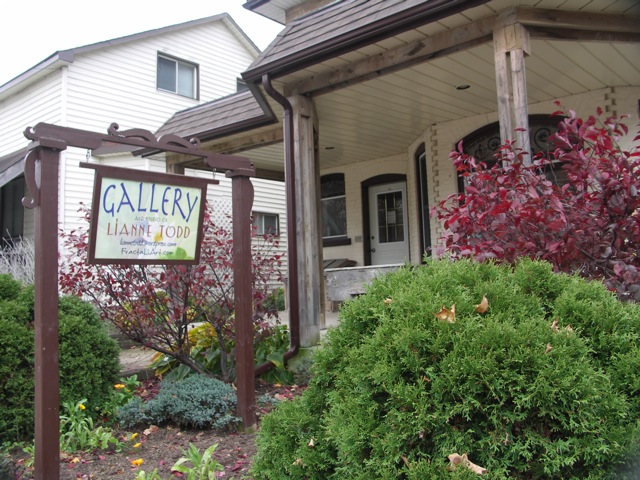
My gallery and studio are actually open all year to anyone who calls ahead or happens by on an afternoon when I’m home. I’ve just put a new sign out front (the old one suffered from weather damage) so you can easily find my location which is right on the Main Street downtown, just a few houses away from the historic mill and waterfall. Look for the yellow flags when you get here and use the map on the postcards (available at each stop) to help.
Here is some information for the tour, and a few photos.
If you find our Facebook page and “Like” us, or any of our posts, we would really appreciate the extra advertising and traffic that provides us – as you can imagine we are on a limited budget and every bit helps!
A Game of Ball
I touched earlier on the aspect of self-similarity on smaller and smaller scales in fractals. I find the ones that are exactly the same on smaller and smaller scales a bit boring – like the Koch snowflake or the Sierpinski arrowhead or the Menger sponge (though it has a nice surprise). It’s the fractals that take on the slightly chaotic characteristics of nature that are the most interesting, and which stimulate the most thought about how this whole complex universe of ours developed.
The series I am presenting to you here does not really look like something you would find in nature, strictly speaking, (except for the parts that look like peacock feathers) but I thought it lent itself well to the illustration of self-similarity while emphasizing the variation. And because it already included elements of a human game, why not present it as a game?
The series is called “The Ball Went Over the Fence”.
Up until this point, you have probably looked at the fractal images on this site and you’ve detected the self-similarity, but what you maybe haven’t seen is what happens when you travel into a fractal. You can’t properly zoom in on a fractal without the equipment to do so – i.e., the software which allows you to make the fractal in the first place, or a video or .gif someone has prepared that takes you through it. When I say travel into a fractal, I mean precisely that – it resembles exploring a new realm. You enter the realm, you set your sights on a distant object, and when you get there, your surroundings have changed – you know you’re in the same realm, because it all looks familiar, but that which was tiny is now large and detailed, and you can see off into a new distance. You set your sights on that, and continue on your journey…. and you can keep doing this over and over again for a long time, depending on how many iterations of the formula you’ve rendered.
So I travelled into this fractal I created, and I stopped along the way and saved some images. The game is for you to try to figure out where I zoomed in to get to the next image. Give it a shot. In a couple of days, I’ll edit this post with the key at the end so you can have the answers. Hint 1: the orientation of the image doesn’t change. Hint 2: Some of these are a lot easier to find than others. Also, the first two images will open larger if you click on them, but the rest are locked at their size. (They are all scaled relative to their actual artwork size). The key at the end will open larger so you can see more clearly.
All images are watermarked and copyrighted.

The Ball Went Over the Fence 1, Lianne Todd. Original Fractal Digital Art, single edition print on metal, 28×28″ $550.00
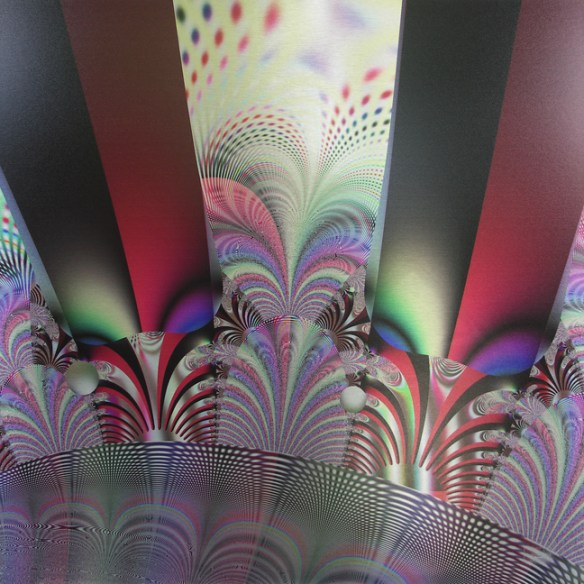
The Ball Went Over the Fence 2, Lianne Todd. Original Fractal Digital Art, single edition print on metal, 20×20″ $345.00
If you are having trouble with the first two, try looking at #2 and #3, this is the easiest solution of all of them.
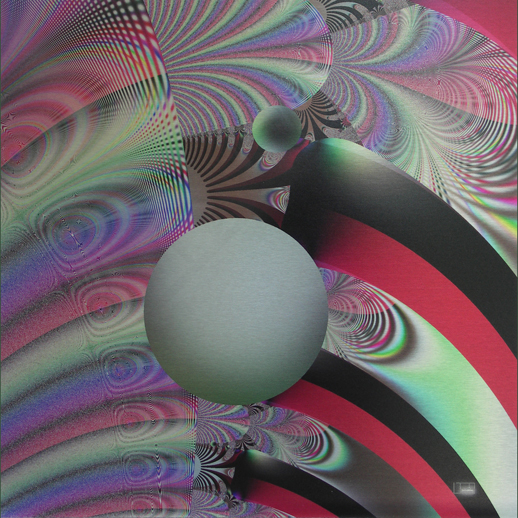
The Ball Went Over the Fence 3, Lianne Todd. Original Fractal Digital Art, single edition print on metal, 16×16″. SOLD. Private Collection.

The Ball Went Over the Fence 4, Lianne Todd. Original fractal digital art, single edition print on metal. 12×12″. SOLD. Private Collection.

The Ball Went Over the Fence 5, Lianne Todd. Original Fractal Digital Art, single edition print on metal, 8×8″. SOLD. Private Collection.
And now, as promised, the key to where the zooms took place – a map through the series:
Fried Eggs
This is just one of my favourites. It’s only little, 6×6″, but like most fractals it took a long time to paint. So many tiny little fried eggs! It’s framed in a black lacquered shadow box frame so that it floats in the frame. The total size, frame and all, is roughly 12×12″.
Yet again, we see a natural shape. Well, natural, in that we are natural and we naturally like to fry eggs. Sometimes I find that it isn’t so much the repetition on smaller and smaller scales that makes me think of natural objects or phenomena when I look at fractals, but the shape that is being repeated.
As usual, it’s copyrighted and watermarked.
Patterns
This piece is called Looking Through.
Looking through what? A microscope? A telescope? A porthole?
In a fractal universe, it doesn’t really matter. Similar patterns are present on multiple scales. Use your imagination!
This image is actually a combination of fractals – one for the thing we are looking through (the self-similarity on smaller scales provides the illusion of perspective and depth here), and one for what we are looking at (this is a flame fractal – more about them later).
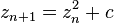
As illustrated here, fractal geometry is quite versatile. I’ve seen some discussion on ‘true’ fractals versus ‘near’ fractals and I would like to address that here for a moment. There seems to be an opinion out there that for a fractal to be ‘true’ it must be a)infinite and b)exactly the same no matter what scale you look at. Having read most of Benoit Mandelbrot’s Fractal Geometry of Nature, I have a problem with these stipulations. First of all, the equation for Mandelbrot’s set is
, with n as the number of iterations, where c is a complex parameter.
There is more to explaining the Mandelbrot set than that, of course, but that is the equation, and if n is a given number, then it’s not infinite, is it? Perhaps the possibility of an infinite number of iterations exists, but that’s an argument for another day.
And even Mandelbrot’s set is not exactly the same on multiple scales. The PATTERN is there, it’s just slightly altered at different scales. It is self-similar. This is one of the things which makes fractal geometry so suitable for modelling the universe.
In my understanding, there was never a suggestion by Mandelbrot, the founder of fractal geometry, that a “true” fractal had to be infinite OR exactly the same on multiple scales. Rather, a fractal is strictly defined as “a set for which the Hausdorff Besicovitch dimension strictly exceeds the topological dimension.”
So, perhaps I’m getting it all wrong, but if you would like to argue I would welcome your discussion.
And now, because I was once a biologist and if you’re anything like me you need a more highly magnified look at that thing, here is a zoom of what you were “looking through” at:
The Photographs
It isn’t difficult to spot natural fractals all around you, if you know what you’re looking for. It’s quite probable that you just don’t recognize them because you haven’t looked at enough computer generated fractals, at enough scales, to realize that even if something in nature doesn’t look like a whole fractal, i.e., you don’t really see the repetition of a pattern on smaller and smaller scales, it will look like part of one.
Before Benoit Mandelbrot came along, nature was regarded as a rather chaotically influenced version of Euclidian geometry. The artist Paul Cezanne said as instruction to young painters: “Everything in Nature can be viewed in terms of cones, cylinders, and spheres.” But Mandelbrot’s famous quote “Clouds are not spheres, mountains are not cones, coastlines are not circles, and bark is not smooth, nor does lightning travel in a straight line” contradicts this, and rings very true.
Some mathematical experts are able to generate entire landscapes, or, small parts of nature like a fern leaf, just using fractal formulas. Benoit Mandelbrot gave a few examples of these in his book, The Fractal Geometry of Nature. Indeed, the generation of natural looking landscapes, textures, etc. using fractals is quite common, in video games. Ever wondered how the game manages to keep up the appearance of the surrounding landscape the character is travelling through? That’s how. They are also used in movies, creating alien landscapes.
Some examples of fractals in nature are depicted in the photographs that were part of my exhibit this summer. The patterns of ice crystal formation, mountain ranges, clouds, branching patterns of trees, growth patterns of mosses and lichens, flower structure, butterfly wings and their coloration, fur growth and patterning… on every scale you can recognize fractals, not just on earth but in the entire solar system and universe. (More about that later). For now, have a look at these, and look at the world in a new way the next time you go outside.
Butterflies and Moths
Insects, and particularly butterflies and moths, are recurring motifs that I often encounter when I’m creating fractals. Sometimes, it’s just the simple shape, and other times it seems to be a whole detailed creature. Sometimes it’s done with what I call the ‘regular’ fractal generator and other times with the flame fractal generator (more on those differences later). If a mathematical formula iterated over and over by a computer can randomly generate images like these in a matter of minutes or hours, imagine what the physical forces of nature and a few billion years of evolution can do with a periodic table of elements (and, shall I say, an underlying fractal structure?). Oh wait, you don’t have to imagine. You can go outside!
(All images are watermarked and copyrighted)