Happy New Year!

I would like to thank everyone who has visited this site in its first calendar year of existence.  And if you’ve shared anything from it, even better!

Today I saw a post by an acquaintance who had begun, a few years ago, a tradition that I think is a wonderful idea.  And I’m telling you about it here because it’s kind of like a fractal.  I hope she doesn’t mind.

She and her husband take a photo of themselves on New Year’s Eve each year, holding a printed photo of themselves they took the year before, holding the photo they took the previous year.  So in each photo, as you zoom in, there is the couple holding the photo… and they get smaller, and smaller….

I wish I had thought of this 29 years ago.

Now, what can you look forward to on the site this year?  More fractals of course.  The ones I haven’t introduced to you yet, and new ones I will be creating.  I hope to do some more experimentation as well.  I’ve got lots of ideas floating around my head and once I settle into the routine after the kids go back to school, there will be plenty of creation happening!  Also, I will be keeping you posted with any news in the world of physics that might pertain to my ideas about the role of fractals in the structure of our universe.

I hope you and yours have a very good year.  And while I’ve got your attention… have a look around you.  Is there enough art on your walls?  😉

Imagining the Cosmos

As you may know, if you have been reading all of my blog posts, I like to dabble a little in cosmology.  Not that I really know anything about it, but it fascinates me, and I like the kind of abstract thought it stimulates.  I was given a Great Course one Christmas on Dark Matter, Dark Energy, The Dark Side of the Universe, which I’ve enjoyed a great deal.  Dr. Sean Carroll is great at explaining cosmology in a way that I, at least, can understand.  I also read Brian Greene’s The Hidden Reality, a fascinating book.  I subscribe to many Facebook Pages which post news about the latest pieces of knowledge in this field.  The abstract thought appeals to me, and I think I’m pretty good at it, but my math and physics skills are limited to helping out my children when they were doing grade twelve homework.  Which may be nothing to sneeze at, but is less than what is required for particle physics.

One of the things that really strikes me, is that the visual components, be they illustrations or actual data translated into an image, of almost every piece of news in cosmology, are recognizable to me as being fractal in nature.  Perhaps it is because I’ve spent so much time looking at fractals, zooming in, and examining them from every angle, that I notice this.  I am always mystified when no mention of fractals is made, in these cases.  I’ve written a  whole post (and another) about fractal dimensions before, so I won’t go into that here, but that’s another part of the puzzle I like to think about.

I know these two fractals don’t really illustrate anything in particular, but they make me think along the lines of particle physics, and stardust, and the early universe.
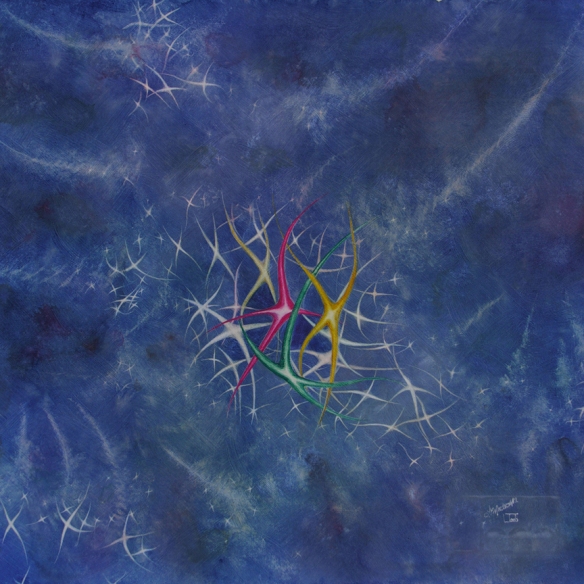
"Stardance". Watercolour on gessoed paper. 20x20". $625.00 Lianne Todd

“Stardance”. Watercolour on gessoed paper. 20×20″.
$650.00
Lianne Todd
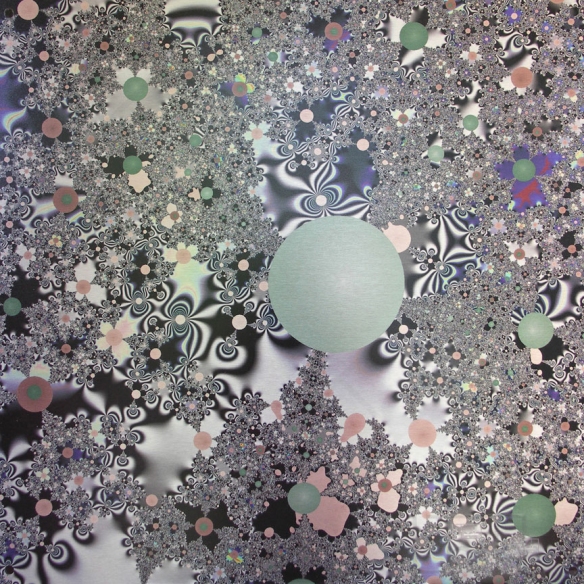
"Particles and Fields". Fractal Digital Art on Metal, single edition print. 20x20". $325.00 Lianne Todd

“Particles and Fields”.
Fractal Digital Art on Metal, single edition print. 20×20″.
$345.00
Lianne Todd

This past summer, during my exhibit, I was told about a person in the same city (London, Ontario) who, it seemed, had a lot of the same thoughts I was having about the fractal nature of the universe.  She is a software engineer and has been studying fractals for much longer than I have!  Needless to say, her math skills are much better than mine.  I was fortunate to meet her (her name is Lori Gardi) this fall.  She has two websites, the first of which I’m going to direct you to Here, in which she has laid out some of her thoughts in a pretty clear way.  I’ll link you to the more recent one later… I think it’s a good idea to start at the beginning of her thought process. We (artists, software engineers, mathematicians, physicists, philosophers) may not all have the same thought processes or reach the same conclusions in our explorations of fractals and their role in the universe, but all avenues should be explored as long as they can exist within the rules that have been truly established by scientists and mathematicians in the past.  I am, unfortunately, not capable of judging whether anything follows those rules, but others who can, need to at least look at this work with an open mind and decide for themselves. ESPECIALLY if it may help solve any of the mysteries still out there.
Further into the realm of Fantasy

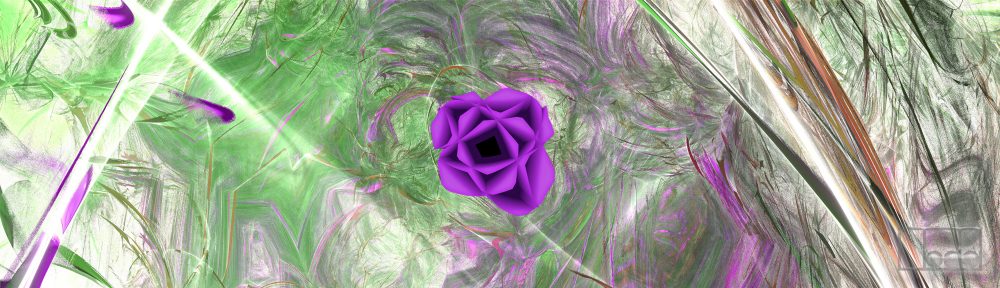
Often, when I’m voyaging through the through the little fractal universes I have generated using the software which I am so thankful exists, I encounter ‘places’ that look like they belong in an illustration for a book I’ve read somewhere along the way. I also encounter characters that look like they belong in those places.  Such was the case for this piece:

The Mage Emerges Digital Art Printed on Metal, single edition 24x24" $425.00 Lianne Todd

The Mage Emerges
Digital Art Printed on Metal, single edition
24×24″
SOLD.  Private collection.
Artist Lianne Todd

The Experiment

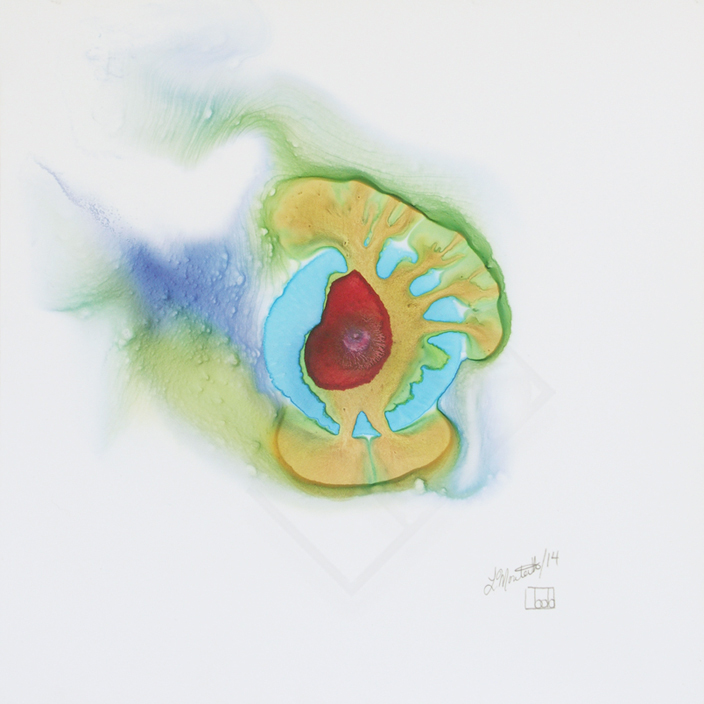
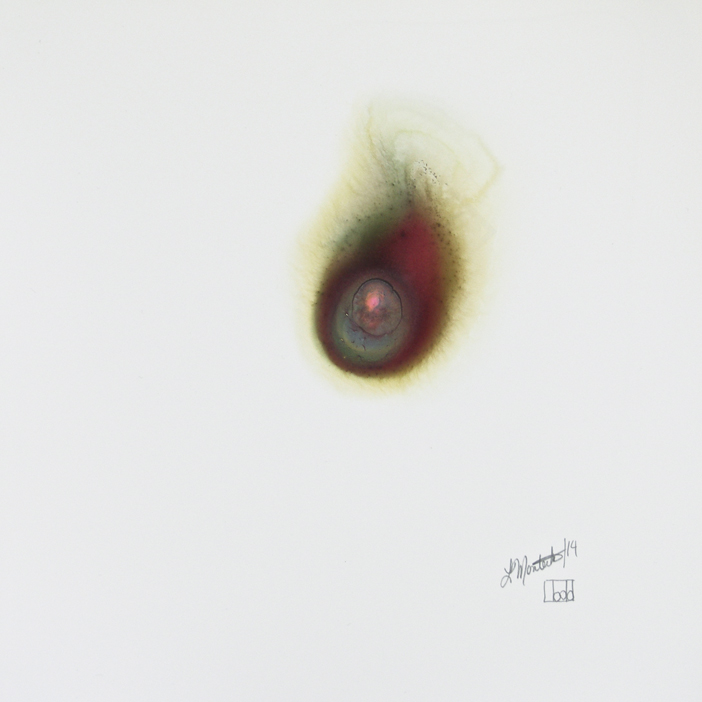
This series of four paintings was an experiment.  Not a very scientific one but I did try to control variables and make predictions.  My hypothesis was that since all pigments are different in their molecule size, shape, and hydrophilic and hydrophobic qualities, they would all move differently through the medium of water, and as they interacted with each other, and that their movement would be fractal.  In other words, I expected them to appear, at the end, as if they were something like a cloud, or some other natural item that is already known to be able to be modelled using fractal geometry.  A coastline, for instance.

All four pieces were executed and controlled in the same way (I won’t give away all my secrets!), the only differences being the pigments I used and the order they were used in.  I tried to reduce the effects of gravity by levelling my table but it is kind of obvious there was a tiny bit of gravitational effect.  I changed the orientation of the final products so that when they were hung together, it would be aesthetically pleasing.  Other than that, the results you see here are basically the raw data.

I called them Negative Nebulae, because I looked at all the white space around them and imagined if it was black, and the colours were reversed, they would look a bit like those photos you see from NASA of distant nebulae.  In other words, these would be like the negatives of those photos.

Here they are – what do you think?:

Nebula Negative I Watercolour on Yupo 10x10" Lianne Todd

Nebula Negative I
Watercolour on Yupo
10×10″ (sold)
Lianne Todd

Nebula Negative II Watercolour on Yupo 10x10" Lianne Todd

Nebula Negative II
Watercolour on Yupo
10×10″ $125.00
Lianne Todd

Negative Nebula III Watercolour on Yupo 10x10" Lianne Todd

Negative Nebula III
Watercolour on Yupo
10×10″ (sold)
Lianne Todd

Negative Nebula IV Watercolour on Yupo 10x10" Lianne Todd

Negative Nebula IV
Watercolour on Yupo
10×10″ (sold)
Lianne Todd

Here is what they looked like at the exhibit:

KONICA MINOLTA DIGITAL CAMERA


Curious to know what they do really look like when you invert the colours?

Non Negative Nebula I (the inversion) Lianne Todd

Non Negative Nebula I
(the inversion)
Lianne Todd

Non Negative Nebula II (the Inversion) Lianne Todd

Non Negative Nebula II
(the Inversion)
Lianne Todd

Non Negative Nebula III (the inversion) Lianne Todd

Non Negative Nebula III
(the inversion)
Lianne Todd

Non Negative Nebula IV (the inversion) Lianne Todd

Non Negative Nebula IV
(the inversion)
Lianne Todd


Phoenix

First of all, thank you to everyone who made it out to see the exhibit at The ARTS Project in London.  It was so nice to see friends, family, and new acquaintances, when I was occasionally there, and share my art with you.  It was also very nice to see some comments in the guest book from very old friends who I hadn’t seen in quite some time! And new friends too!  (You all know who you are!).  If you did get to the show, and didn’t see me or sign the guest book, I would love to know.  Please comment below, or send me an email.

Today I’m going to share one of my very favourite pieces, a metal print called Phoenix, in case you didn’t make it to the show.  I’m choosing it first for two reasons: 1) It isn’t what those who are only a little familiar with fractals might imagine when thinking of fractal art, and 2) It is a prime example of the way a metal print shows off the digital art I have created.

I will let you first refer to this photo from the opening night.  See the piece second from the end on the long wall?  The one that doesn’t look like anything?  That’s Phoenix.  It’s actually quite dark, and from the angle of the camera, the lighting isn’t picking up the image.  That’s one of the things I like.  It’s kind of mysterious.

photo 1

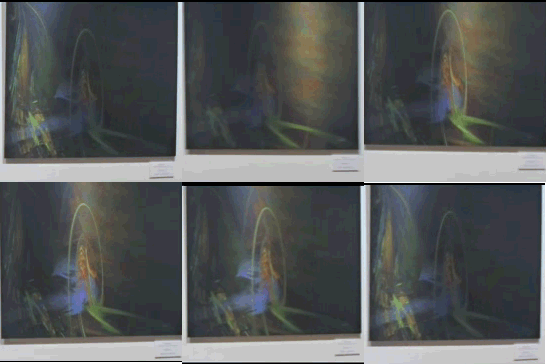
Now, I will show you what happens when you walk by this image as it was lit in the gallery.

Walking Past Phoenix

Walking Past Phoenix

Now that you’ve seen it in action, I will show you a watermarked image I took of it with my camera in the light of day.  I think this would be fantastic in a very brightly lit minimally decorated room, don’t you?  Alternately, it would be wonderful in a very darkly decorated room with a few track lights focused on it.  I hope it captures your imagination the way it does mine.

Phoenix, (c) 2014 Lianne Todd 24x24" original metal print (single edition)

Phoenix, (c) 2014
Lianne Todd
24×24″ original metal print (single edition) $450.00