Fractal Machinery

I just wanted to say thank you to all the studio tourists who took their precious weekend time to drive out my way and visit my studio.  It was a pleasure to meet you or see you again, and I had fun giving brief explanations of fractals and their significance when you showed an interest.  If you want to see some more of them in person, right now there are four on display at the restaurant Sixthirtynine in Woodstock, ON.  A very fine restaurant suitable for a special dinner date!

On the tour weekend I presented a few new fractals.  This is one of them (watermarked):

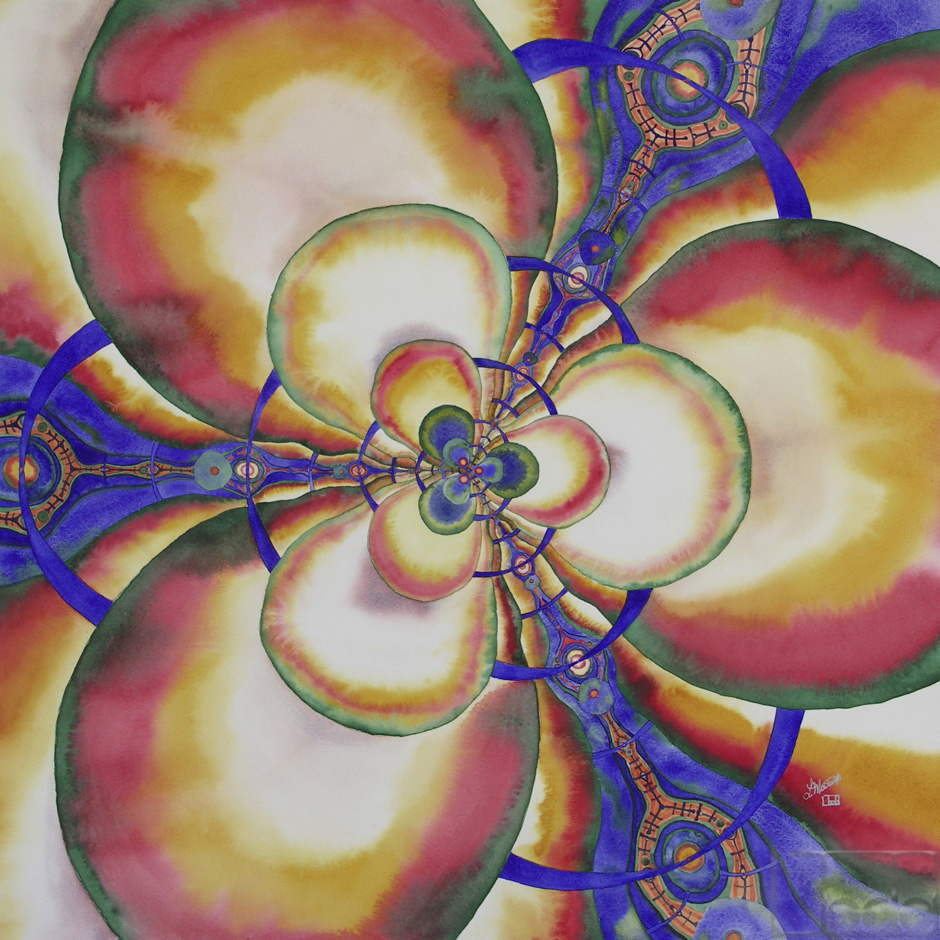
Pretty Cogs in the Big Machine. Fractal Digital Art printed on metal, single edition. 24x24". $425.00 Lianne Todd

Pretty Cogs in the Big Machine.
Fractal Digital Art printed on metal, single edition. 24×24″.
$450.00 © Lianne Todd

This one doesn’t really reflect the natural world so much as it reflects our complicated man-made world.  It’s not likely that most cogs in our machines are this pretty, but there is definitely a complexity in our modern technology that has beauty.  Some of that complexity, for instance, is contained in the very machine you are viewing this on.  Maybe there are no cogs, but the minutiae of its workings have to rival the intricacy they feature.  The background of this piece could also be compared to the circuitry involved in some of our other more powerful pieces of technology.  For instance, if you have a smart phone, the antenna that makes it all work had to be a fractal, or we simply wouldn’t have smart phones.

For a while I was referring to this image to myself as the steampunk fractal, as I have recently become enamored with all things steampunk.  However, giving it such a title didn’t seem to really fit.  These are far from steampunk-type gears, they aren’t real, and the machinery is not reminiscent of anything very old-fashioned.  This is just a nod to the genre!


Oxford Studio Tour this coming weekend

It seems that the first weekend of May has crept up on me and while I’ve been posting about the Oxford Studio Tour on my Facebook page and my Twitter account (@artnaturali), and on my other website, I neglected to do so here!  It’s this coming weekend already and I hope you haven’t made other plans yet.

I will be in my gallery/studio which is Stop #7 on the tour, to welcome you all this weekend. Visitors will be flocking to Oxford County, Ontario to view, enjoy, and purchase art.  I have an abundance to show.  Many of my fractal paintings, photos, and original single edition prints will be here, and many of my original paintings of other subjects.  These include watercolour paintings on traditional paper, on gesso-coated paper, and on yupo.  I will have two brand new fractal metal prints on display, as well as a new piece printed on acrylic!  In addition to this, there will be some new fractal photos, and some new non-fractal pieces in watercolour.  Brochures for the tour are available at a number of locations – including here at my studio!  To get you started, here is a map to my location.  I’m about an hour from Hamilton/Burlington, an hour from London, or an hour from Kitchener/Waterloo.

2015 oxford studio poster smP.S. I accept cash and cheques for purchases of my art – but not credit cards, sorry!  (There is an ATM at the Royal Bank just down the street though).

Turbulence Revisited

Big whorls have little whorls
Which feed on their velocity,
And little whorls have lesser whorls
And so on to viscosity.
-Lewis F. Richardson

In the book I reviewed in my last post, Chaos: The Making of a New Science, by James Gleick, this quote begins one of the chapters.  And in the first paragraph of that chapter, another quote is mentioned which is in the description of this interesting video about the unexpected math in Van Gogh’s Starry Night.

James Gleick makes no reference to that painting, but goes on to describe the stories of past mathematicians and physicists trying and failing to solve the problem of turbulence.  Finally, along came Chaos Theory and Fractal Geometry, and things started to make some sense.  It is easy to understand why, when you look at the self-similarity and the complex patterns of a turbulent system.

I wonder what was going through Van Gogh’s mind when he was painting Starry Night.  According to the video, it was during one of his “periods of psychotic agitation”.  Perhaps the patterns approaching chaos happening in the electrical signals of his brain were translated to his expression with paint?  It’s an interesting point to ponder when you consider all of the systems in our bodies that involve fractal patterns.

I can assure you I was perfectly calm and sane during the painting of Turbulence and Bubbles – I was just letting my own hands and brain interpret the patterns that arose from an external fractal formula.  When I first started I had a completely different title in my mind, but then as I was painting it, I realized the black whorls reminded me of turbulence, and it looked like the yellow parts were bubbles emerging from some unknown source within it, and merging with each other when they touched.  We know turbulent systems do produce bubbles… (think boiling water)… I doubt this is how, but still!   I know I’ve introduced it before but here it is again:

Turbulence & Bubbles. Watercolour on Gessoed Paper. 20x20". $625.00. Lianne Todd

Turbulence & Bubbles.
Watercolour on Gessoed Paper.
20×20″.
$650.00.
Lianne Todd

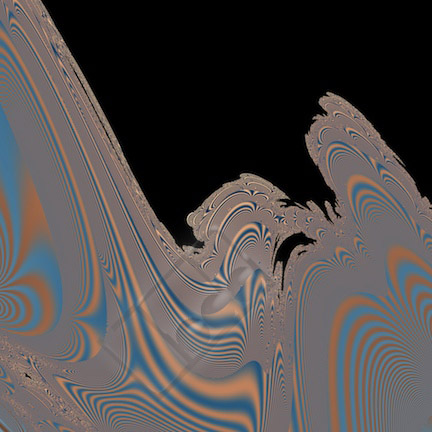
Here is a raw fractal which, to me, looks like a cross section of a wave crashing in.  A detail, below it, shows the patterns present within.  I haven’t quite decided what I’m doing with this one yet, but thought I would show it to you as it relates to this post so well.  It’s not exactly turbulence, as there aren’t any true whorls, but you can see how fractal geometry would lend itself to the study of turbulent systems.

waveeditsmwaveeditcrop

Pics of the current show

The Station Arts Centre has turned out to be a great location for my original series of fractal art.  Their new lighting system really shows off the metal prints well, and the one wall was the perfect length to show off the larger paintings all together.  Much better than crowding them into my home gallery, that’s for sure!

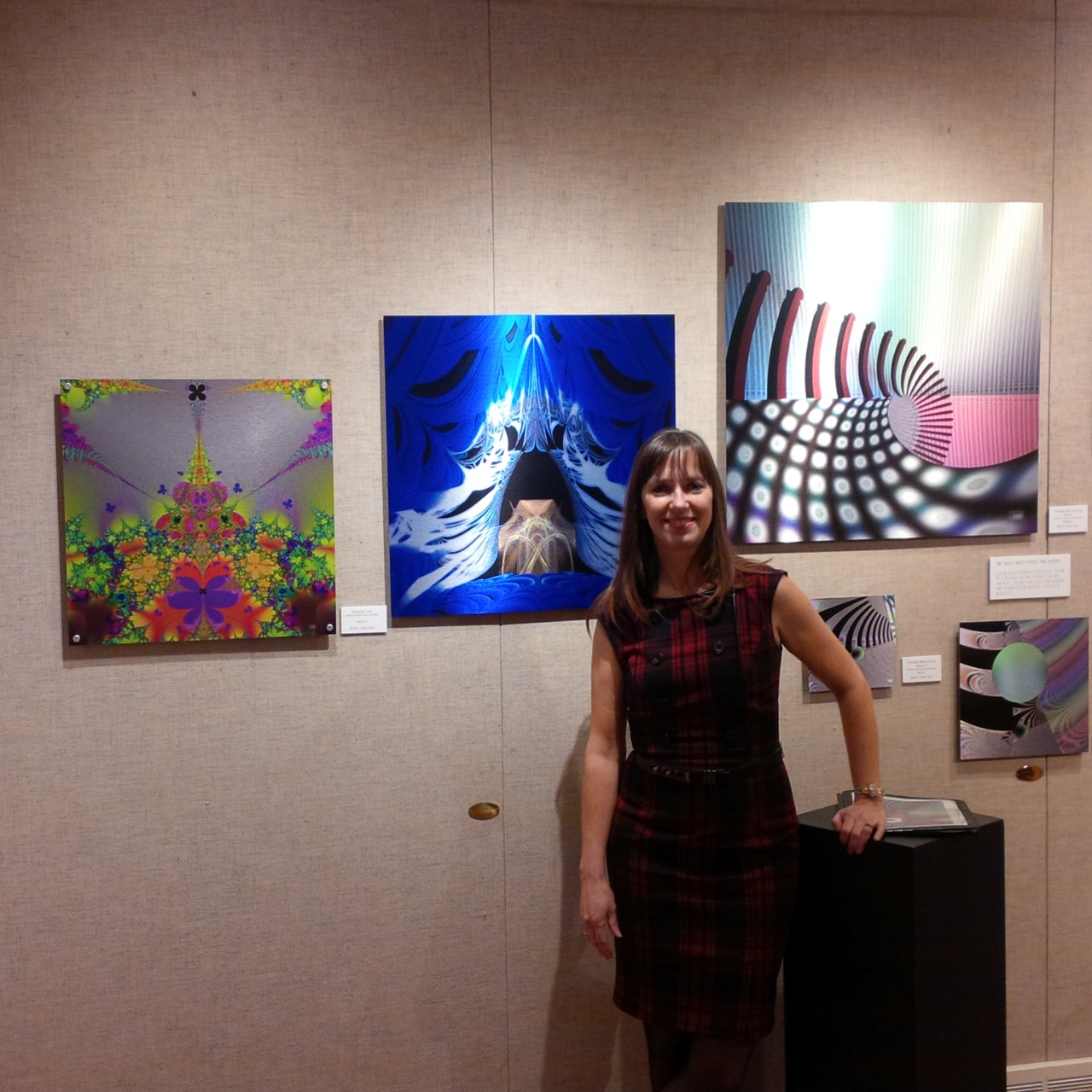
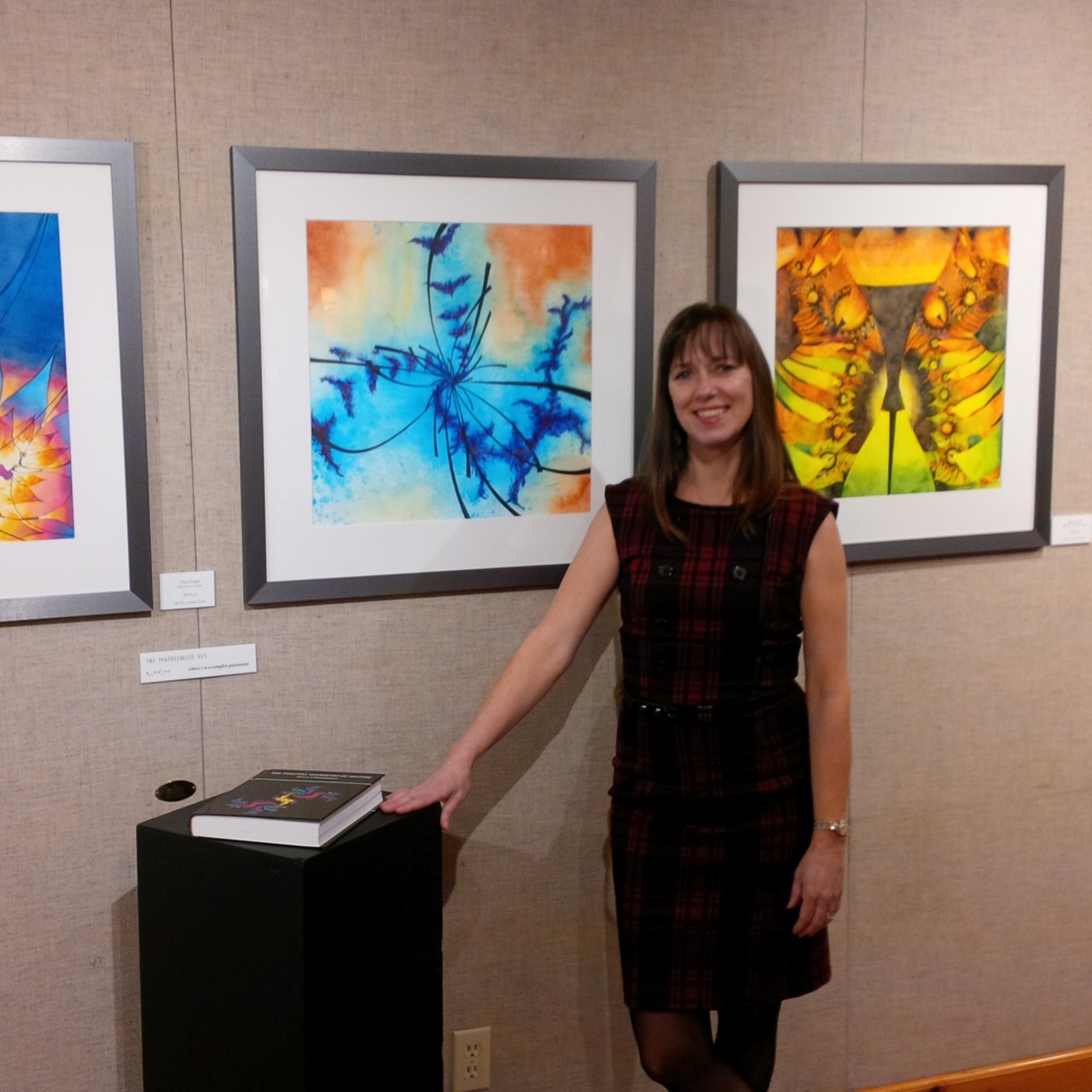
Here I am with a few of the pieces, on the night of the opening:

Lianne+Metal PrintsLianne+PaintingsAlso, the Station Arts Centre took a few photos on the night of the opening and posted them on their Facebook page.  You can view them here.

The show runs until April 7.


Show Reprisal!!

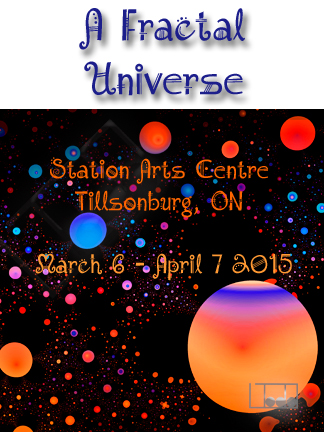
I haven’t written in a little while but I now have some great news for followers in the area who haven’t had a chance to see my fractals in person yet.  I am showing those that are left (31 pieces) at the Station Arts Centre in Tillsonburg for the month of March.  The show opens March 6 (this Friday) at 7-9 pm.  It runs until April 7.  The show is called, this time, A Fractal Universe.  Come land in it!

AFractalUniversegraphicwb

Patterns of humanity

I have mentioned a few times in previous posts about fractal images often being archetypal.  I’m not really sure I was correct in describing them that way, but what I will say is that they often look familiar in a way that transcends their immediate translation into a real object.  For instance, when I first looked at this fractal image, I immediately thought of the Aztecs and the patterns they incorporated into their art forms.  Having now looked at some Aztec art in more depth, I’m not even sure why I thought of them, other than the  feather motif and the colours.  That’s just what immediately came to mind.  And I have other fractal images created (not shown here) which really speak to me of Native American blanket patterns.  Others might look at this piece and be more immediately aware of the hourglass shape.  Maybe you will look at it and see something else entirely.

My point is, from near the beginning of humanity, we have been making patterns, whether or not they were drawn with a stick in the sand, sculpted along the edge of a stone building’s rooftop, painted on a cathedral ceiling, or digitally on a tablet.  Possibly for 60,000 years, we have been making patterns!  And if you look at all the patterns we have been making, you may notice that many of them are self-similar on smaller and smaller scales.  We were making fractals and we didn’t have a name for what was common to them all.  And we didn’t have a concept of the way fractals were involved in the geometry of nature – not consciously, anyway.  Maybe we were consciously inspired by nature, but didn’t recognize that specific aspect of it.  Only for the last 30-40 years have we, thanks to Mandelbrot, come to an awareness of this common denominator.  I like the way fractals connect all of humanity over time, and the way they connect us to nature.   I’m really looking forward to exploring this with future pieces!

Aztec Gold. Watercolour on Gessoed Paper. 20x20". $625.00. Lianne Todd

Aztec Gold.
Watercolour on Gessoed Paper.
20×20″.
$650.00.
Artist Lianne Todd

Biological Forms

Examples of fractals in biology are not difficult to find, and indeed if the universe is fractal, there should be a fractal component to all biological forms.  In the post entitled The Photographs, in which I have captured some natural fractal forms, there are at least five forms which are biological.  In the post entitled Butterflies and Moths, there were several digitally generated fractals which just happened to look biological.  Anyone who has looked up the word fractal has probably been given the example of the fern, or the romanesco, or even the tree.  In fact, people can create extremely realistic looking plants using software that takes advantage of fractal geometry.  Our lungs, and our vascular systems are obviously fractal in nature.  Ever looked at a sea slug?  Beautiful little fractals.

When I create my fractal digital art, and sometimes watercolours, I don’t try to make things that are biological, but I recognize natural forms when I see them and they pop up on their own all the time.  The fact that I’m not making them on purpose somehow speaks to my scientific side, and relates them to evolutionary theory.  I talked about this a little bit in The rose and the creation process as well.

These two pieces are examples which are maybe not as obvious as the butterflies but do remind me of biology just the same.

Cell Division. Lianne Todd. Watercolour on Aquabord. 6x6". $175.00

Cell Division.
Lianne Todd.
Watercolour on Aquabord.
6×6″.
$175.00

Triad. Lianne Todd. Watercolour on Paper. 20x20". $625.00

Triad.
Lianne Todd. Watercolour on Paper.
20×20″.
$650.00


Happy New Year!

I would like to thank everyone who has visited this site in its first calendar year of existence.  And if you’ve shared anything from it, even better!

Today I saw a post by an acquaintance who had begun, a few years ago, a tradition that I think is a wonderful idea.  And I’m telling you about it here because it’s kind of like a fractal.  I hope she doesn’t mind.

She and her husband take a photo of themselves on New Year’s Eve each year, holding a printed photo of themselves they took the year before, holding the photo they took the previous year.  So in each photo, as you zoom in, there is the couple holding the photo… and they get smaller, and smaller….

I wish I had thought of this 29 years ago.

Now, what can you look forward to on the site this year?  More fractals of course.  The ones I haven’t introduced to you yet, and new ones I will be creating.  I hope to do some more experimentation as well.  I’ve got lots of ideas floating around my head and once I settle into the routine after the kids go back to school, there will be plenty of creation happening!  Also, I will be keeping you posted with any news in the world of physics that might pertain to my ideas about the role of fractals in the structure of our universe.

I hope you and yours have a very good year.  And while I’ve got your attention… have a look around you.  Is there enough art on your walls?  😉

Physical Phenomena

If I am postulating that the universe is fractal in nature, it makes sense that structures formed by molecules behaving in their natural way should be recognizable as fractals.  Such is the case with frost, turbulence, and bubbles.  Just do a little Google search with each of those terms alongside fractal, and you’ll see what I mean.  Mandelbrot made groundbreaking progress modelling turbulence, which had confounded mathematicians before him, using fractal geometry.

It also makes sense that in my random wanderings through the fractal universes I create, I encounter images that remind me of these phenomena.  Such is the case with these two fractals which I chose to paint.  I especially like the way the bubbles in Turbulence & Bubbles look like they are in the process of being blown, sometimes from multiple locations, and melding together when they meet, just like real bubbles would.

Hot Frost. Watercolour on Aquabord. 6x6". $175.00 Lianne Todd

Hot Frost.
Watercolour on Aquabord.
6×6″.
$175.00
Lianne Todd

Turbulence & Bubbles. Watercolour on Gessoed Paper. 20x20". $625.00. Lianne Todd

Turbulence & Bubbles.
Watercolour on Gessoed Paper.
20×20″.
$650.00.
Lianne Todd

Imagining the Cosmos

As you may know, if you have been reading all of my blog posts, I like to dabble a little in cosmology.  Not that I really know anything about it, but it fascinates me, and I like the kind of abstract thought it stimulates.  I was given a Great Course one Christmas on Dark Matter, Dark Energy, The Dark Side of the Universe, which I’ve enjoyed a great deal.  Dr. Sean Carroll is great at explaining cosmology in a way that I, at least, can understand.  I also read Brian Greene’s The Hidden Reality, a fascinating book.  I subscribe to many Facebook Pages which post news about the latest pieces of knowledge in this field.  The abstract thought appeals to me, and I think I’m pretty good at it, but my math and physics skills are limited to helping out my children when they were doing grade twelve homework.  Which may be nothing to sneeze at, but is less than what is required for particle physics.

One of the things that really strikes me, is that the visual components, be they illustrations or actual data translated into an image, of almost every piece of news in cosmology, are recognizable to me as being fractal in nature.  Perhaps it is because I’ve spent so much time looking at fractals, zooming in, and examining them from every angle, that I notice this.  I am always mystified when no mention of fractals is made, in these cases.  I’ve written a  whole post (and another) about fractal dimensions before, so I won’t go into that here, but that’s another part of the puzzle I like to think about.

I know these two fractals don’t really illustrate anything in particular, but they make me think along the lines of particle physics, and stardust, and the early universe.

"Stardance". Watercolour on gessoed paper. 20x20". $625.00 Lianne Todd

“Stardance”. Watercolour on gessoed paper. 20×20″.
$650.00
Lianne Todd

"Particles and Fields". Fractal Digital Art on Metal, single edition print. 20x20". $325.00 Lianne Todd

“Particles and Fields”.
Fractal Digital Art on Metal, single edition print. 20×20″.
$345.00
Lianne Todd

This past summer, during my exhibit, I was told about a person in the same city (London, Ontario) who, it seemed, had a lot of the same thoughts I was having about the fractal nature of the universe.  She is a software engineer and has been studying fractals for much longer than I have!  Needless to say, her math skills are much better than mine.  I was fortunate to meet her (her name is Lori Gardi) this fall.  She has two websites, the first of which I’m going to direct you to Here, in which she has laid out some of her thoughts in a pretty clear way.  I’ll link you to the more recent one later… I think it’s a good idea to start at the beginning of her thought process. We (artists, software engineers, mathematicians, physicists, philosophers) may not all have the same thought processes or reach the same conclusions in our explorations of fractals and their role in the universe, but all avenues should be explored as long as they can exist within the rules that have been truly established by scientists and mathematicians in the past.  I am, unfortunately, not capable of judging whether anything follows those rules, but others who can, need to at least look at this work with an open mind and decide for themselves. ESPECIALLY if it may help solve any of the mysteries still out there.